Compare Locations Consistently
Evaluate multiple candidate locations using the same scoring logic.
A simple, interpretable score that helps businesses compare locations, prioritize opportunities, and make better expansion decisions.
Location decisions are complex. A promising area may have strong footfall but too many competitors. Another area may have lower traffic but stronger residential demand. Landhep’s Composite Location Score helps businesses compare locations by combining multiple data signals into a structured and interpretable score.
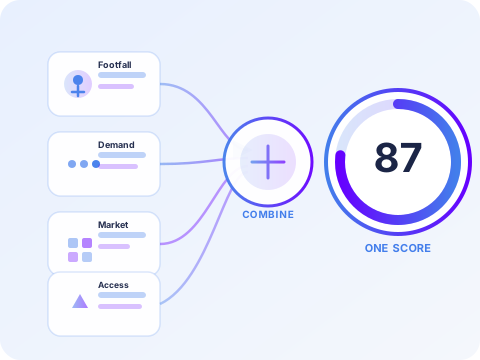
Without a structured scoring framework, location decisions can become subjective. Different teams may evaluate locations using different assumptions, making it difficult to compare options fairly. Composite scoring creates a consistent method to assess locations based on the factors that matter most to the business.
Evaluate multiple candidate locations using the same scoring logic.
Shortlist high-potential areas before investing in deeper field surveys or negotiations.
Support location decisions with data signals, not only intuition or anecdotal evidence.
Give strategy, sales, operations, and management teams a shared view of location potential.
Adapt the scoring model based on the business type and customer behavior.
The Composite Location Score can include different indicators depending on the use case.
Demand signals help estimate potential customer interest or market need in an area.
Supply signals help understand existing market presence, competition, and saturation.
Accessibility signals help evaluate how easy it is for people to reach the location.
Contextual signals help describe the character and relevance of an area.
There is no universal best location. Landhep builds Composite Scores based on industry-specific location logic.
Meal-time traffic, office catchment, residential density, delivery potential, and competitor intensity.
Commercial traffic, shopping area strength, competitor density, and customer catchment.
Residential catchment, accessibility, healthcare facility gaps, and population density.
Family residential areas, school proximity, student catchment, and accessibility.
Road access, vehicle movement proxy, residential zones, and service coverage gaps.
Rank candidate locations before making rental, acquisition, or expansion decisions.
Evaluate existing branch coverage and identify areas for improvement.
Prioritize cities, districts, or neighborhoods with stronger potential.
Find areas with strong demand signals but limited existing supply.
Prioritize field sales, merchant acquisition, or customer outreach zones.
Support business cases for new locations with structured location evidence.
Landhep can help you build an industry-specific scoring model for your next expansion or market planning decision.
Talk to Landhep